
What Happens on a Coral Reef After Dark

A coral reef does not go to sleep when the sun drops below the horizon. It changes shifts.
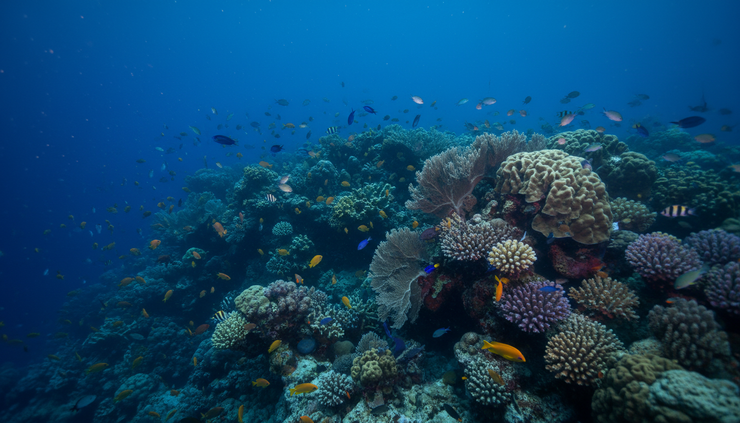
By day, the reef can look like a bright, busy neighborhood. Butterflyfish pick at coral. Damselfish hover over their tiny territories. Wrasses dart in and out of ledges. Then the light fades, and the same reef becomes quieter, stranger, and more secretive. Many daytime fish vanish into hiding places. Hunters slide out from caves. Coral polyps open like thousands of tiny hands reaching into the current.
What happens on a coral reef after dark is not a pause in reef life. It is a full changeover, with different animals, different behaviors, and different risks.
The daytime residents retreat
Many of the reef’s most colorful fish are easiest to see during the day. That is when they feed, defend small territories, clean other fish, or move across coral heads in loose groups. At night, visibility drops and the rules change. For a small fish, open water near a reef can become dangerous fast.
So, many daytime fish hide.
They tuck themselves into cracks, caves, branching coral, sponge openings, and tight spaces under ledges. Some wedge in so snugly that currents and predators have a harder time pulling them out. Others choose the same shelter night after night, using the reef’s structure like a familiar house.
This retreat can make a reef look suddenly empty. A camera that showed fish crossing the frame all afternoon may seem still after sunset. But the fish have not left. They have pulled back into the reef’s architecture.
Some species take nighttime defense even further. Certain parrotfish are famous for producing a mucus covering before they rest. The fish secretes the material around its body, forming a loose cocoon. Researchers think this covering may help in more than one way. It may reduce scent cues that lead predators or parasites to the fish. It may also act as a barrier against small biting organisms.
That image can seem strange at first, a fish sleeping inside a self-made bubble. On a reef, though, strange often means practical. Night brings a new set of threats, and animals that survive there usually have more than one trick.
Other daytime fish rely on color changes. Some species that look bright in sunlight appear duller at night. Their patterns may fade or shift, making them less noticeable in dim light. Since many reef predators hunt by scent, vibration, and movement as well as sight, hiding still matters as much as blending in.
A sleeping reef fish is not sleeping in the way a person does. It may rest, reduce movement, and become less responsive, but it still has to remain aware enough to survive. The reef after sunset rewards caution.
The nighttime hunters emerge
As the daytime fish retreat, nocturnal animals begin to move.
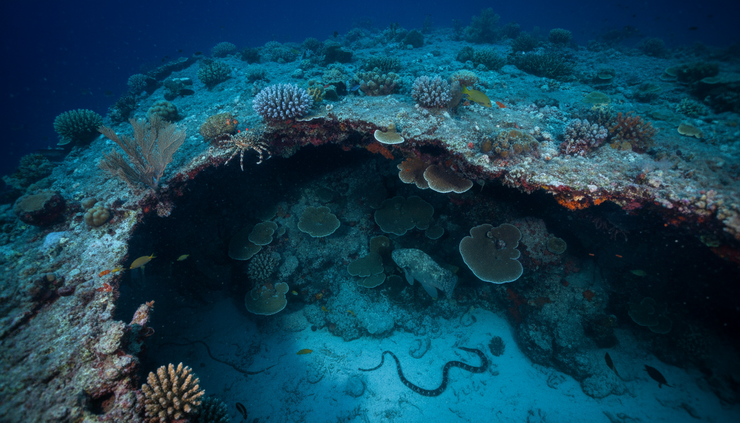
Moray eels poke their heads from holes and crevices. Crabs step across coral rubble. Shrimp move through dark gaps. Lobsters leave dens, waving their long antennae as they explore. These animals often spend daylight hours hidden from larger predators or bright light. After dark, they gain an advantage.
Moray eels are among the most recognizable nighttime hunters on reefs. Their long bodies let them move through narrow spaces where many fish cannot follow. They often wait with their heads visible and mouths opening and closing. That motion can look threatening, but it helps them move water across their gills.
Some morays hunt fish. Others specialize in prey with shells. Zebra morays, for example, are known for feeding on hard-shelled animals such as crabs, mollusks, and sea urchins. Their blunt teeth help crush rather than slice. At night, when many crustaceans are active, this feeding style fits the reef’s schedule.
Crustaceans also become much more visible after sunset. Crabs that were hidden during the day may climb across rocks and coral. Spiny lobsters can march out from shelters, often staying close enough to retreat if danger appears. Tiny shrimp may appear as quick flashes of movement near anemones, coral branches, or rocky holes.
For a reef watcher, the signs can be subtle at first:
A pair of eyeshine points under a ledge
A slow eel head turning toward the current
A crab claw reaching from a crack
A lobster antenna crossing the frame before the body appears
A sudden burst of movement from an animal that was invisible seconds earlier
Night does not make the reef less active. It makes the activity less obvious. Daytime reef life often happens in open view. Nighttime reef life often happens along edges, openings, and shadows.

The coral itself begins feeding
Corals may look like rocks, branches, fans, or plants, but they are animals. A coral colony is made up of many tiny animals called polyps. Each polyp has a mouth and a ring of tentacles. During the day, many corals keep those tentacles partly or fully withdrawn. After dark, many extend them into the water.
This is one of the most fascinating changes on a night reef.
The tentacles are not decorative. They are feeding tools. Coral polyps use them to capture plankton and other tiny organisms drifting in the current. Many coral tentacles contain stinging cells that help catch small prey. Once captured, food moves toward the polyp’s mouth.
Corals also rely on a partnership with microscopic algae that live inside their tissues. These algae use sunlight during the day and provide energy to the coral. That daylight partnership is one reason many reef-building corals thrive in clear, shallow tropical water. But corals are not only solar-powered partnerships. They feed as animals too, and night gives them a chance to catch what the current brings.
Under low light, a coral colony can look transformed. A smooth surface may become fuzzy. A hard-looking coral head may reveal hundreds of extended tentacles. A reef camera that seemed to show motionless coral during the day may show a field of tiny movements after sunset.
This feeding behavior also connects the coral to the rest of the reef food web. Plankton move with currents. Small animals feed on plankton. Larger animals feed on the small animals. Nutrients pass from drifting life into fixed colonies and then through the reef.
The change is easy to miss if the camera is not close enough or if the light is too harsh. A gentle light source, or a camera suited for low light, can reveal tentacles without washing out the scene. In person, divers and researchers take care with nighttime lighting for the same reason. Too much disturbance can change animal behavior.
For remote viewers, the best clue is texture. If a coral that looked smooth in daylight suddenly appears soft, bristly, or flower-like, the polyps may be feeding.
Different animals use different senses after dark
Night on a reef is not simply daylight with the lights turned off. It changes which senses matter most.
Vision still plays a role, especially during twilight or under moonlight. Some animals have eyes suited for dim conditions. Others track movement and contrast. But smell, vibration, touch, and taste become especially useful after dark.
Moray eels have a strong sense of smell. Crustaceans use their antennae to gather information from their surroundings. Fish tucked into crevices may respond to pressure changes, nearby movement, or contact. Many animals reduce unnecessary motion because movement can give them away.
The reef itself creates a complex acoustic and physical environment. Water carries sound and vibration well. Snapping shrimp can create sharp crackling sounds. Fish may produce grunts, clicks, or other noises. Waves and currents move through coral branches and rocky channels. To an animal on the reef, darkness does not mean emptiness. It means information arrives in different forms.
This is why nighttime reef footage sometimes feels mysterious. Human viewers rely heavily on vision. If the frame looks dark and still, it may seem like nothing is happening. The animals are reading a richer set of signals.

Some reefs stage a rare nighttime event
Most reef nights bring small changes: hidden fish, active eels, feeding corals, and roaming crustaceans. Some nights bring something much larger.
On certain reefs, corals take part in synchronized spawning. During these events, many coral colonies release eggs and sperm into the water around the same period. The timing varies by species and location, but environmental cues can include water temperature, seasonal patterns, sunset timing, and lunar cycles.
Mass coral spawning is one of the great natural events of the ocean. Instead of each colony releasing reproductive cells at random, many release them close together. That timing increases the chance of fertilization. In the water, bundles or clouds of reproductive material rise from coral colonies and drift with the current.
For viewers, it can look like the reef is releasing tiny stars.
These events are rare to catch live because the timing can be narrow. They may happen on only a few nights in a season for some species. Conditions have to line up, and a camera has to be pointed at the right place at the right time. Even when scientists can predict likely windows, nature does not follow a perfect schedule.
That unpredictability adds to the wonder. A reef livestream may show ordinary nighttime life for many evenings, then suddenly reveal a reproductive event that connects thousands of coral animals across a reef.
Synchronized spawning also shows that corals are not passive background structures. They grow, compete, feed, respond, reproduce, and build habitat for countless other organisms. A living reef is both a place and a community of animals.
A live reef camera can show a new world after sunset
A live reef camera may look quiet during the day if the frame is fixed on one coral head or a patch of reef. Fish pass through. Light shifts. The scene feels calm. After local sunset, that same view can become far more interesting, but in a different way.
The key is patience.
Nighttime reef behavior often comes in moments. An eel appears, then pulls back. A crab crosses the frame and vanishes. Coral tentacles extend slowly. A sleeping fish becomes visible only after your eyes adjust to the shadows. If the camera includes the local time, it becomes easier to understand what you are seeing. A reef that looks dark at 8 p.m. local time may be entering peak nocturnal activity, even if it is daytime where the viewer sits.
A local time display helps in another way. Coral reefs exist across many time zones. Checking the reef’s local sunset matters more than checking your own clock. If a camera is on a reef in the Pacific, Caribbean, Indian Ocean, or elsewhere, the best viewing window depends on that reef’s day and night cycle.
A good viewing habit is simple: watch the same camera at different times. Compare late afternoon, just after sunset, late evening, and pre-dawn. The reef will not look the same.
You may notice:
Day fish returning to shelter as light fades
Eels becoming more visible from caves and reef holes
Crabs and lobsters moving across the bottom
Coral polyps extending tentacles into the current
Fish resting in cracks, under ledges, or among coral branches
More activity near the edges of the frame than in the open center
The best reef cameras make small behavior easier to see. Stable framing, low-light performance, and a visible local time display can turn a seemingly quiet scene into a record of an active nighttime ecosystem.
Quick facts about reef life after dark
What to know | Details |
Best viewing time | After local sunset |
Watch for | Eels, crabs, lobsters, extended coral tentacles, and sleeping fish |
Rare event | Mass coral spawning |
Helpful feature | Display the camera’s local time beside the livestream |
The reef changes shifts, not seasons
The daily rhythm of a reef is one of its most important patterns. Day and night divide work across the community. Some animals feed in sunlight. Others wait for darkness. Some hide from daytime predators, then become predators themselves after sunset. Corals use the daylight through their algal partners, then many extend tentacles at night to capture food from the water.
That rhythm helps explain why a reef can never be fully understood from a single visit, a single photograph, or a single hour of video. A midday reef and a midnight reef are the same place, but they reveal different lives.
The next time a reef camera looks still, check the local time. If sunset is near, keep watching. The bright daytime fish may soon disappear into the reef. An eel may ease out from a cave. A lobster may step from under a ledge. Coral that looked like stone may begin to feed.
On a coral reef, sunset is not the end of the day—it is the beginning of another world.


Comments